.png)

Cycling the Camino de Santiago from León: complete stage-by-stage guide

Cycling the Camino de Santiago from León is one of the most balanced ways to experience the French Way. The journey covers roughly 310–320 kilometres, crosses Maragatería, El Bierzo and the mountains of O Cebreiro, and finishes in Santiago’s Plaza del Obradoiro. Six days allow a sensible pace, time for major sights and the atmosphere of the Camino.
At a glance: 6 recommended stages, medium difficulty with two demanding sections, and the best balance of weather and crowds usually in April–June and September–October. BikeLeón can deliver a checked, size-adjusted and equipped MTB or e-bike in León; at the end you return it in Santiago, close to the Cathedral.
How far is León from Santiago by bike?

The practical cycling distance is about 313 km, although it varies with the chosen cycling alternative, accommodation access and detours. The walking path is not always the best cycling line: mud, technical surfaces or crowds may make a signposted alternative or quiet local road safer.
Recommended duration
5 days: for trained cyclists, with long stages and limited sightseeing time.
6 days: the best-balanced option and our general recommendation.
7 days: ideal for first-timers, mixed-ability groups or a relaxed trip.
Recommended 6-stage itinerary
Stage 1. León – Astorga | about 49 km | easy to moderate
Before leaving, visit León Cathedral, San Isidoro and Gaudí’s Casa Botines. The route heads towards La Virgen del Camino and crosses the open plateau. The essential stop is Hospital de Órbigo, with its remarkable medieval Passo Honroso bridge. Astorga rewards you with Gaudí’s Episcopal Palace, the Cathedral and Maragato cuisine.
Services are plentiful in León, Hospital de Órbigo and Astorga. This is a good stage for checking adjustments and getting used to the bike.
Stage 2. Astorga – Ponferrada | about 54 km | moderate to high
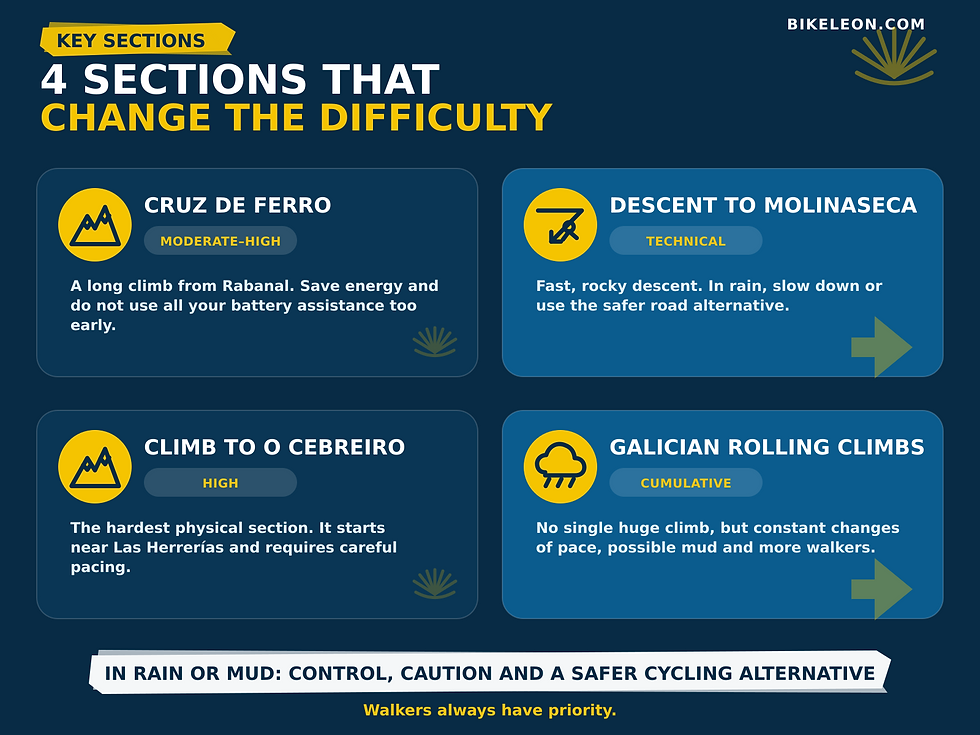
After Castrillo de los Polvazares and Rabanal del Camino, the climb leads to Cruz de Ferro, one of the Camino’s most symbolic places. The descent through Manjarín, El Acebo and Molinaseca is long, fast and at times technical; descend cautiously, especially in rain.
The Knights Templar Castle is Ponferrada’s must-see monument. Molinaseca also deserves a stop by its bridge and river.
Stage 3. Ponferrada – O Cebreiro | about 50 km | high difficulty
The route crosses Bierzo vineyards through Cacabelos and Villafranca del Bierzo. The decisive climb starts near Las Herrerías. It is the hardest physical section, with a sustained gradient, changing surface and unpredictable weather.
O Cebreiro is essential for its pallozas, the pre-Romanesque church of Santa María la Real and its views. E-bike riders should start fully charged and save assistance for the final climb.
Stage 4. O Cebreiro – Sarria | about 44 km | moderate
Although mainly downhill, there are still climbs such as Alto do Poio. At Triacastela choose the more direct San Xil route or the longer Samos alternative to visit its monastery. Sarria offers every service and is the most popular walking start.
Stage 5. Sarria – Palas de Rei | about 47 km | moderate
Expect repeated climbs and descents through woods, villages and traditional lanes. Portomarín’s fortress-like Church of San Nicolás and reservoir views are highlights. The route continues through Castromaior and Ligonde. The challenge is accumulated elevation and the larger number of walkers.
Stage 6. Palas de Rei – Santiago | about 69 km | moderate to high
The final stage is the longest. Stop in Melide for octopus and in Arzúa for its cheese. After Pedrouzo, climb Monte do Gozo for the first view of the Cathedral towers. Entering Santiago and reaching the Obradoiro is the great finale.
Allow time to arrive calmly, collect the Compostela if eligible and return the bike at BikeLeón’s agreed point close to the Cathedral.
Ten unmissable stops
León Cathedral and Casa Botines.
Passo Honroso bridge in Hospital de Órbigo.
Episcopal Palace and Astorga Cathedral.
Cruz de Ferro.
Molinaseca and Ponferrada’s Templar Castle.
Villafranca del Bierzo.
O Cebreiro and Santa María la Real.
Samos Monastery if you take that alternative.
Portomarín, Melide and Monte do Gozo.
Santiago Cathedral and Plaza del Obradoiro.
MTB or e-bike?
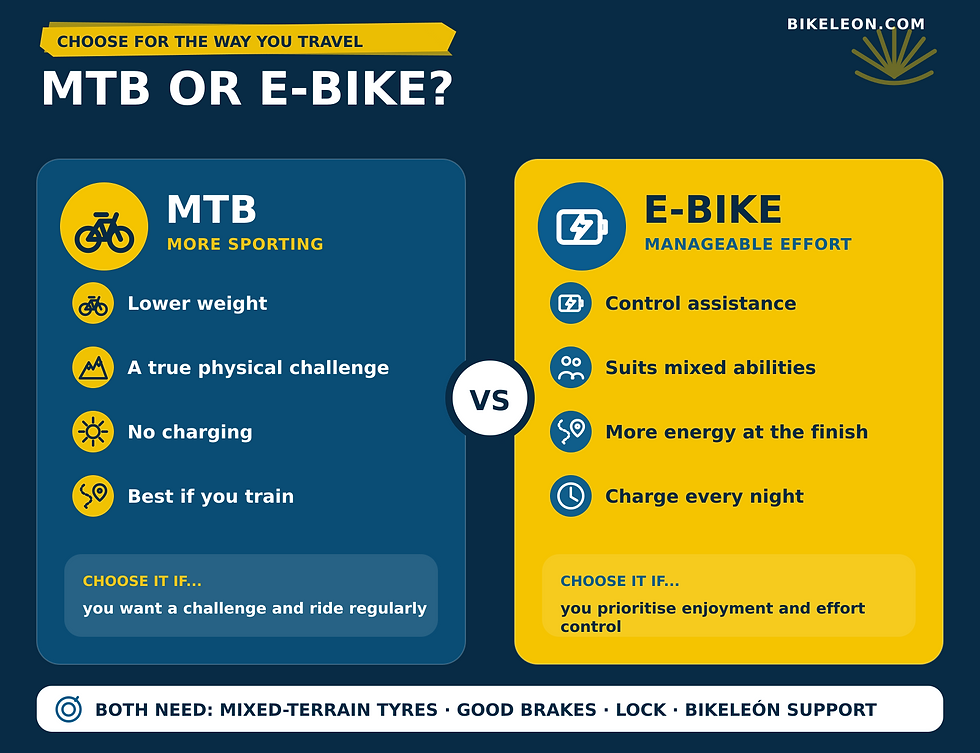
Choose an MTB if you train regularly, want a sporting experience and can ride several hours each day. An e-bike helps manage effort, brings mixed-ability groups together and leaves more energy for sightseeing. It still requires pedalling, weighs more and must be charged every night.
For this route, suitable mixed-terrain tyres, reliable brakes, a rack and securely attached panniers matter. BikeLeón supplies the bike assembled, checked and adjusted to your height, with route equipment and basic insurance. Assistance and additional protection options are available subject to the rental conditions.
Services along the route
Accommodation and charging: hostels, hotels and rural stays; confirm locked bike storage and permission to charge an e-bike.
Food, water and supplies: cafés, restaurants, supermarkets and fountains. Restock in larger towns because village opening hours can be limited.
Health and money: pharmacies, health centres and cash machines are concentrated in León, Astorga, Ponferrada, Sarria and Santiago.
Repairs and transport: workshops, taxis, coaches and luggage-transfer services are easy to find in larger towns but scarce in mountain areas.
Around Cruz de Ferro, the O Cebreiro climb and rural sections of Galicia, start with water, food, a controlled battery level and a small repair kit.
Best season and weather
The best balance is usually April–June and September–October. July and August offer long days but more heat, walkers and full accommodation, especially after Sarria. Winter can bring snow and ice at Cruz de Ferro and O Cebreiro. Rain is possible in Galicia throughout the year.
Check the forecast each morning, carry waterproof clothing and never rush a technical descent in poor visibility.
Pilgrim credential and Compostela for cyclists
Cyclists must document at least the final 200 km to Santiago, collect stamps and meet the Pilgrim Office’s conditions to obtain the Compostela. León is far enough away to cover that distance. Always check the current rules before travelling.
What cyclists should pack for the Camino

Divide your equipment into three groups. Essentials stay with you, tools and accessories go on the bicycle every morning, and spare clothing can travel in the transferred bag.
Keep with you: helmet, gloves, glasses, rain jacket, water, ID, credential, phone, money and essential medication.
On the bike · every morning: pump, tube or tubeless kit, tyre levers, multitool, lights, lock, food and the charger if you use an e-bike.
In the luggage: light spare clothing, rest shoes, a small wash bag and a warm layer. Avoid packing items just in case.
Practical rule: less weight means more control, fewer mechanical problems and a much more enjoyable journey.
Elevation, terrain and real difficulty
The route is not extremely technical, but it involves many hours in the saddle. León–Astorga mixes tracks and tarmac with limited climbing; Astorga–Ponferrada includes the climb to Cruz de Ferro and a long technical descent; Ponferrada–O Cebreiro contains the hardest ascent. Galicia brings repeated short climbs, dirt lanes and occasional rocky or muddy sections. Rain, excess luggage and limited training significantly increase the difficulty.
Technical sections and cycling alternatives
Cyclists do not have to follow every metre of the walking trail. On the descent from Cruz de Ferro, the climb to O Cebreiro and some sections between Sarria and Santiago, a quiet local road or cycling alternative may be safer. In mud, poor visibility or heavy pedestrian traffic, prioritise control and always give way to walkers. Never descend an unfamiliar trail too quickly.
E-bike range and charging
Range depends on rider and luggage weight, elevation, wind, temperature and assistance mode. Start every day fully charged, use Eco on flatter ground and save stronger assistance for Cruz de Ferro, O Cebreiro and the repeated Galician climbs. Carry the charger and confirm secure overnight charging with your accommodation. Do not plan a stage using only a theoretical range figure.
Getting to León and travelling home from Santiago
León has rail and coach connections; arriving the previous afternoon is recommended. BikeLeón coordinates delivery of the prepared bike at the agreed point, avoiding boxes and last-minute assembly. At the end, return the bike in Santiago close to the Cathedral. Santiago offers rail, coach and air connections; book early in high season.
Accommodation, luggage and food
Choose accommodation with secure bike storage and, for e-bikes, charging access. Daily luggage transfers are provided by specialist companies: BikeLeón rents and supports the bicycle but does not transport personal luggage. Carry water and food between villages, and try Maragato stew, Bierzo botillo, O Cebreiro cheese, octopus in Melide, Arzúa cheese and Santiago almond cake.
Did you know your luggage can be moved stage by stage?

Yes: specialist companies collect your suitcase or backpack from the departure accommodation and deliver it to the next stage finish. You can then ride with only a small day bag.
Common operators on the French Way include Jacotrans, Paq Mochila by Correos, Pilbeo and Camino Cómodo. They are independent from BikeLeón and must be booked directly.
Book: provide the date, collection accommodation and delivery accommodation for every stage.
Label: identify the bag clearly and leave it at the place and time specified by the accommodation.
Transfer: the operator collects it in the morning and carries it to the next accommodation.
Check: weight limit, stage distance, coverage, season, price and what happens if an accommodation has no reception.
As a reference, Correos currently publishes a 15 kg limit and a maximum 60 km transfer for Paq Mochila; every operator has its own conditions. Always confirm them when booking.
Do not transfer your ID, money, essential medication, rainwear, phone or any charger needed during the stage. BikeLeón rents and supports the bicycle but does not carry personal luggage.
Recommended daily routine
Check tyre pressure, brakes, fasteners, gears and battery before breakfast. Start early, especially in summer and on the O Cebreiro and Santiago stages. Take a short break after 60–90 minutes, eat before you feel hungry and drink regularly. On arrival, charge the e-bike, confirm the luggage movement and review the next day's route and weather.
Safety and sharing the Camino
Walkers have priority on narrow trails. Slow down, warn politely and overtake only with enough room. Use lights in fog, rain or poor visibility and avoid headphones that block your surroundings. At every stop, secure the frame to a fixed object and store the bike indoors overnight.
Water, food and recovery
Do not assume that every village fountain or café will be open. Carry enough water and restock in larger towns. Small regular snacks work better than a heavy meal halfway through the stage. After riding, rehydrate, eat protein and carbohydrates, stretch gently and rest. Increasing pain in the knees, back or hands often means the riding position, saddle height or luggage distribution should be checked.
Key services by stage

The infographic covers seven services: sleep, food, shops, pharmacy, workshop, e-bike charging and luggage transfer. Green means wide availability; yellow means plan ahead; orange means limited availability.
Astorga and Ponferrada are the best places to buy supplies, find a pharmacy or solve a mechanical adjustment. Before O Cebreiro, restock in Villafranca del Bierzo and arrive with accommodation booked, enough food and a controlled battery level.
Sarria again has every service, but also greater demand. Palas de Rei covers basic needs and Santiago offers a full range plus the BikeLeón return point near the Cathedral. Always confirm opening hours in small villages.
Renting with BikeLeón
BikeLeón specialises in Camino de Santiago rentals. Choose your bike type and size, receive it ready in León and ride to Santiago without arranging return transport. At the end, return it at the agreed point close to the Cathedral.
The idea is simple: start with the right bike, useful equipment and real support behind you. Check availability and book your León–Santiago bike early, especially for an e-bike or a specific size.
Frequently asked questions
Can a relatively inexperienced cyclist do it?
Yes, with preparation and sensible stages. For a first trip, choose 6 or 7 days and consider an e-bike.
Must cyclists always follow the walking trail?
No. Some sections are technical, muddy or crowded. Choose the safer alternative and always give priority to walkers.
Where can I charge an e-bike?
Usually at your accommodation. Carry the charger and confirm secure access to a power outlet in advance.
Should I book accommodation?
Not always, but it is strongly recommended from May to October and for groups.
What if the bike breaks down?
Use the supplied kit for simple adjustments and contact BikeLeón if a breakdown prevents you from continuing, following the assistance procedure in your booking.
How much training should I do before leaving León?
You do not need to be a competitive cyclist, but you should know how your body reacts to several consecutive days of riding. During the previous 4–6 weeks, aim for 2–3 rides per week and at least one weekend with two back-to-back riding days. Friendly advice: do not test only whether you can ride 60 km; test whether you can get back on the bike the next morning without your whole body protesting.
Which section is genuinely the hardest?
The climb from Las Herrerías to O Cebreiro is the most serious physical effort. The descent from Cruz de Ferro towards El Acebo and Molinaseca, however, demands more skill and caution. The two mistakes I would protect you from are spending all your energy before O Cebreiro and descending from Cruz de Ferro too quickly.
Which stage is most deceptive?
Palas de Rei to Santiago. It looks manageable on paper, but it is roughly 69 km, comes with accumulated fatigue and includes repeated climbs, junctions and more walkers. Do not start late thinking the job is already done: the Obradoiro is still a long way off, and you deserve to arrive without rushing.
Can people with very different fitness levels ride together?
Yes, but the person who is struggling should set the pace. An e-bike can balance a group very effectively, while agreed meeting points prevent anyone from having to chase wheels. Arriving half an hour later will not spoil the Camino; turning every stage into a race might.
Is carrying a large backpack a good idea?
Not for six stages. It traps heat, loads your neck and shoulders and often increases hand and lower-back discomfort. Use properly secured panniers or a daily luggage-transfer service, and carry only a small day bag with the essentials.
How much luggage should I actually take?
Less than you think: two sets of cycling clothes, light clothes for the evening, a waterproof, one warm layer, comfortable shoes and a small wash bag usually cover the essentials. If the panniers are overfilled or the bike handles differently, you have packed too much. ID, money, medication and essential items should always stay with you.
Should I use brand-new shorts, shoes or gloves on day one?
Ideally, no. Test everything that will touch your body for hours: shorts, gloves, footwear, pedals and saddle height. A minor rub in León can become a wound before Sarria. Collect new memories on the Camino, not untested equipment that can ruin it.
What should I do if my knees or back hurt or my hands become numb?
Stop and address the cause before it worsens. Check saddle height and angle, riding position, handlebar reach and luggage distribution; reduce the pace and change hand position regularly. Increasing discomfort or sharp pain is not cured by being tougher, so seek professional advice if it persists.
What time should I start each stage?
Early enough to avoid the strongest heat, leave room for a mechanical problem and encounter fewer walkers, especially after Sarria. Eat breakfast, check the bike and leave in daylight. Starting early helps; riding in darkness merely to gain half an hour adds an unnecessary risk.
Do I need GPS when the Camino has yellow arrows?
An offline route is strongly recommended. The arrows are primarily intended for walkers and may lead you onto an awkward or technical section for a bicycle. Use GPS as support, not as an autopilot: if the terrain feels wrong, stop and check the cycling alternative.
What should I do in rain, mud or fog?
Change the objective: that day is about arriving safely, not proving anything. Choose a quiet local road when the trail loses grip, increase braking distance, use your lights and avoid technical descents. Mud can turn an easy section into a completely different challenge.
What if I am already far behind schedule at midday?
Do not try to recover an hour by descending recklessly or skipping food. Reassess the remaining distance, inform your accommodation and luggage operator if applicable, and shorten the stage or arrange a transfer when necessary. The itinerary is there to help you; it is not an obligation worth taking risks for.
Does tubeless mean I cannot get a puncture?
No. Sealant fixes many small punctures, but it cannot prevent a large cut, sidewall damage or major pressure loss. Carry a pump, tyre plugs and an emergency inner tube, and learn how to use them before departure. If the problem prevents you from continuing, follow the BikeLeón assistance procedure included with your booking.
Should I carry cash and food even though the route crosses many villages?
Yes. A small village café may be closed, unable to accept cards or have no signal. Carry some cash, water and an emergency snack that requires no preparation. Restock in León, Astorga, Ponferrada, Villafranca del Bierzo, Sarria and other larger towns before entering areas with fewer services.
Can I receive the Compostela after cycling from León?
Yes. The route from León exceeds the 200 km required for a cycling pilgrimage. You must use an accepted pilgrim credential, follow an official Camino towards Santiago and meet the stated religious or spiritual purpose. To be safe, obtain at least two stamps per day during the final 200 km and check the current rules with the Pilgrim’s Office. Pilgrim’s Office.
Book your bike
Check availability and book here: https://www.bikeleon.com/product-page/alquiler-bicicletas-leon-santiago


Comments